Behind the question
Someone Pays
A cheap shirt has a price tag. The people who make it carry a different kind of bill.
Updated:
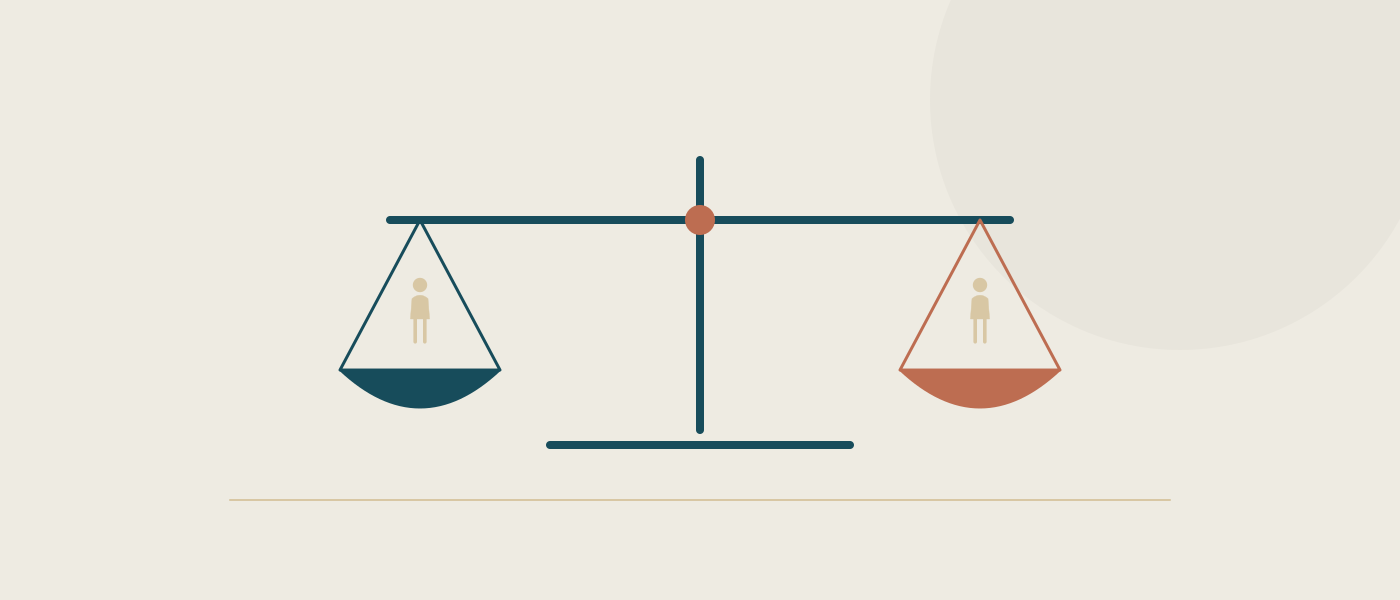
Naseer wanted a factory with only one storey. After what he had survived, the height of a building was no longer a detail to leave to somebody else.
In an ILO account published in 2015, he and his friend Jahangir had opened New Life, a small garment workshop in Bangladesh. Both had survived the collapse of Rana Plaza. The women they employed had survived it too. Naseer described a workplace with shared ownership and profits, where production pressure would not rule every hour. They began with two secondhand sewing machines. The account recorded eight by the time of the visit. It was a modest beginning, and an enormous ambition: to make a living without asking people to leave their safety at the door.
I keep returning to that ambition. In our usual stories about business, the moment worth noticing is the opening: the founder, the risk, the first customer. Here, what matters is also the shape of the working day. How high is the building? Who can slow the pace? Can someone who has already been hurt return to earning a living without being pushed beyond what they can bear?
Those questions are easy to lose on the journey from a sewing machine to a shop window. A shirt arrives folded. Its label tells us how to wash it. Its price tells us what the retailer asks. Neither tells us how much of another person’s strength has already been spent.
On 24 April 2013, Rana Plaza collapsed. The ILO’s 2021 retrospective records 1,138 workers killed and more than 2,500 injured. Each number belongs to a life that extended beyond a workplace. There were people waiting for someone to come home. There were routines that depended on a wage. The scale is difficult to comprehend precisely because grief does not happen at the scale of a statistic. It happens to one family, and then another.
Distance lets the rest of us continue. The next collection appears. The next delivery arrives. A purchase takes a few minutes, while the consequences of making it may travel through years. I do not think ordinary shoppers can personally investigate every thread in every garment. That expectation would turn a shared responsibility into an impossible private homework assignment. But our inability to see everything should make us more demanding about what businesses must see.
The same question reaches well beyond clothing. Consider, as an ordinary imagined example, a small café that remains open because its owner never takes a day off. The accounts might show a viable business. The owner’s exhaustion may appear nowhere. Or imagine a supplier that meets every deadline by borrowing time from workers’ sleep. Delivery looks reliable from one end of the chain. From the other, reliability has become a debt collected from bodies.
These are examples to think with, not reports of particular businesses. Their familiarity is what troubles me. We know how easily a cost disappears when the person carrying it is outside the frame. We also know that the disappearance of a cost on paper does not make the strain disappear in a life.
The wider figures are sobering. In estimates released in 2023, the ILO put annual work-related deaths at nearly three million and non-fatal occupational injuries at 395 million. Those are worldwide figures across sectors, including deaths from occupational disease. They cannot tell us what happened in any single company. They do tell us that protecting health and life at work remains an unfinished promise.
There is a temptation to answer all this with a better label. Responsible. Ethical. Sustainable. I understand the desire for a word that makes a complicated choice feel settled. Yet a reassuring word can also bring the looking to an end. I want it to begin a conversation: whose life became easier, whose became harder, and what happens if this arrangement continues?
That conversation must include economic survival. Work can only remain dependable if a business can pay its bills. Orders, prices and payment schedules help decide whether care is possible in practice. A humane working day needs customers who allow enough time and money to make it happen. Otherwise the promise is left for the person with the least room to refuse.
Such questions change how I think about success. A full order book can be good news and still leave an urgent question about the conditions under which those orders are fulfilled. The people making a business possible should be able to recognize themselves in the account of what it has achieved. Their continued well-being belongs inside that account.
We can begin by paying attention when someone asks for a slower pace, a safer room, or time to recover. Listening may disrupt a convenient schedule. Ignoring the request can leave a person carrying a burden that everyone else has agreed to stop seeing.
When I think about what deserves to be called sustainable, I think of that single storey. Of a workday a person can finish. Of earning a living and still having enough life left to live.